

QuikBot Technologies, a Singapore-based deep-tech startup building the Ambient Permission Plane, the Trust Infrastructure for Physical AI that governs how autonomous systems operate in the real world, and the pioneer behind the world’s first Agentic AI-orchestrated Autonomous Final-Mile Delivery Platform-as-a-Service (AFMD PaaS) for urban logistics in smart cities, today announced a strategic partnership with Embed Financial Group Holdings (“EFGH”), a Singapore-headquartered financial infrastructure company building the Finternet by embedding payments, insurance, and financial services into digital and physical systems across Africa and Asia, to embed insurance directly into its infrastructure.
Through this partnership, insurance becomes a native layer within the Ambient Permission Plane, introducing a first-of-its-kind architecture where risk is embedded directly into how autonomous systems are authorised, governed, and executed in real-world environments.
This enables a new model in which every autonomous action, from robots operating within buildings to systems interacting across shared urban infrastructure, can be insured in real time.
As Physical AI deployments scale, organisations face growing challenges around liability, safety, and accountability. At the same time, the industry faces a broader deployment gap, driven by fragmented systems, a “Tower of Babel” lack of interoperability, and “hallucination risks” where AI decisions are not fully aligned with real-world constraints and policies.
QuikBot’s Ambient Permission Plane serves as a foundational infrastructure layer that standardises identity, policy, and execution across robots, buildings, and urban systems. By embedding insurance directly into this layer, every approved action becomes authorised, governed, and insured by design.
Unlike traditional insurance models that operate outside system workflows, this framework integrates policy issuance, risk assessment, and claims processes directly within QuikBot’s platform, enabling dynamic, context-aware coverage aligned with real-time system behaviour.
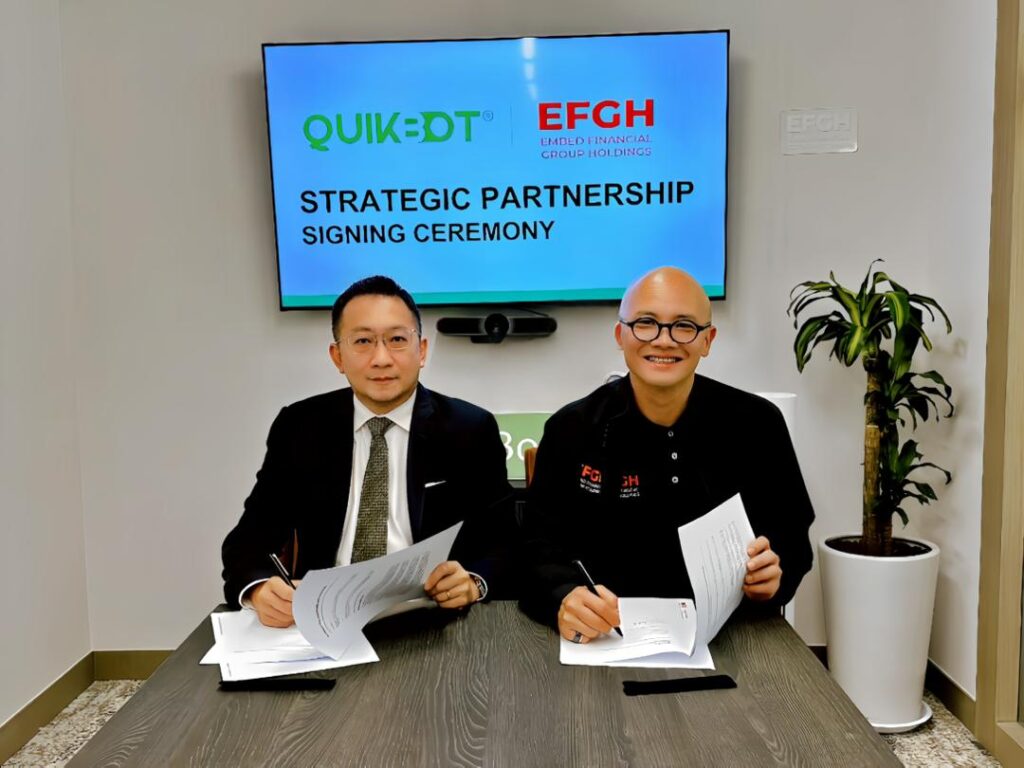
“Physical AI is reaching a point where trust, not just intelligence, determines whether systems can scale,” said Alan Ng, Founder and CEO of QuikBot Technologies. “The Ambient Permission Plane defines how machines operate in the real world. By embedding insurance into this infrastructure, we are making risk a native property of the system. Every action is authorised, accountable, and insured by design. This is how Physical AI scales safely and at city-level.”
“At EFGH, we believe the Finternet extends beyond payments and banking. It encompasses every financial service that can be embedded into the fabric of daily life and commerce,” said Dennis Ng, Executive Chairman of EFGH. “Autonomous systems are becoming a defining feature of how buildings, logistics networks, and cities operate, introducing a new class of risk that must be addressed intelligently. Our partnership with QuikBot enables us to embed protection directly into the infrastructure that governs these systems. This is embedded finance converging with Physical AI, and it represents a powerful shift.”
EFGH will develop modular risk solutions covering public liability, cyber risk, product defects, business interruption, and goods in transit, tailored to environments such as commercial buildings, residential developments, retail spaces, and logistics hubs.
QuikBot’s infrastructure is already deployed across major developments in Singapore, including South Beach, and Mapletree Business City, with a new deployment at Punggol Digital District scheduled for May 2026, and expansion underway across the Middle East, including Dubai, and Asia.
By unifying authorisation, execution, and risk coverage into a single infrastructure layer, QuikBot and EFGH are establishing a new standard for how autonomous systems are deployed, governed, and scaled in real-world environments.